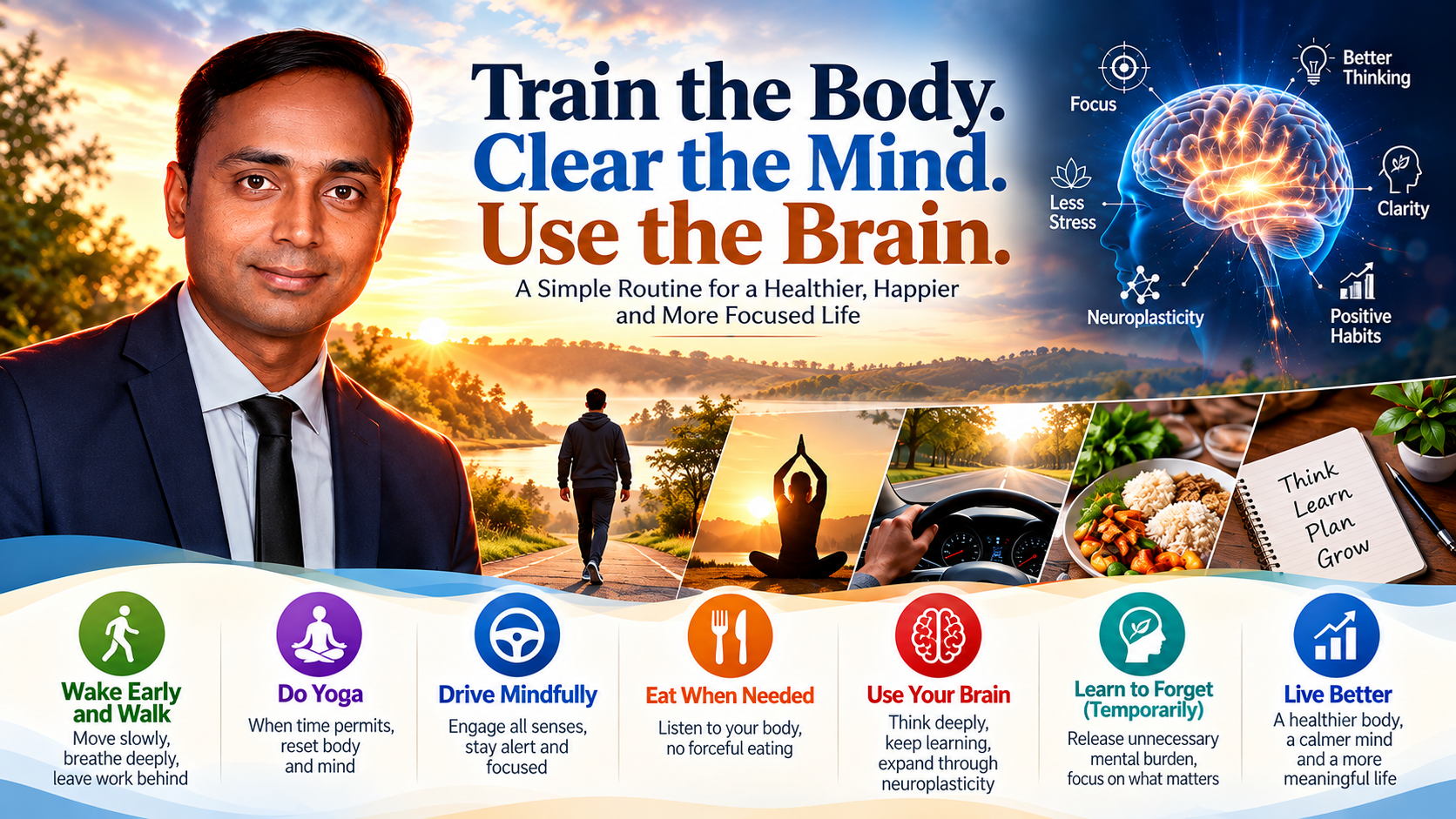
PERSONAL DISCIPLINE • PRACTICAL WELL-BEING • MENTAL CLARITY
Train the Body.
Clear the Mind.
Use the Brain.
A personal philosophy of walking, breathing, yoga, attentive driving, mindful eating, thinking deeply, and learning when to let go
“The brain is a gift. What we do with that gift is our responsibility.”
This essay begins with a simple daily routine, but its real subject is discipline: how to keep the body moving, protect attention, reduce unnecessary mental load, and use the mind deliberately instead of allowing every problem to occupy it.
A practical note: this is a personal wellness philosophy, not a medical prescription. Anyone with a medical condition, injury, pregnancy, diabetes, an eating disorder, sleep disorder, or other special health need should adapt it with professional guidance.
The Routine Is Simple. The Meaning Is Deeper.My day begins early—usually between 4:30 AM and 5:30 AM. I walk slowly. I do not run. During that walk I make one deliberate decision: office work does not come with me. The road is for walking, breathing, observing, and allowing the mind to become quiet before the demands of the day arrive.
If time permits, I add yoga. Later, when I drive, I treat driving as a discipline of attention: eyes on the road, awareness of traffic, signals, pedestrians, other drivers, speed, distance, and changing conditions. I eat when my body genuinely asks for food instead of eating simply because a clock or habit commands me. And through all of this, I try to remember one principle: the brain may be given to us by biology, family, and—according to one’s faith—by God, but its use is in our hands.
The purpose of this routine is not to create a complicated lifestyle. It is the opposite. It is an attempt to remove noise, restore awareness, and make space for useful thought.
My Routine at a Glance
|
1. Wake early |
Usually 4:30–5:30 AM, provided adequate sleep has been protected. |
|
2. Walk slowly |
No need to race. Move, observe, breathe, and let the nervous system settle. |
|
3. Leave office work behind |
Do not turn the walk into a moving meeting or a problem-solving session. |
|
4. Breathe naturally and deeply |
Comfortable, unforced breathing—never dizziness, breath-holding, or strain. |
|
5. Add yoga if time allows |
Mobility, balance, breathing, and mental steadiness. |
|
6. Drive with total attention |
Treat driving as an exercise in focus—not as physical exercise and never as a time for multitasking. |
|
7. Eat with body awareness |
Notice genuine hunger and fullness while still respecting nutrition, health needs, and regularity. |
Early morning has a special quality: fewer messages, fewer calls, less traffic, and fewer people asking for something. For many people, that quiet makes it easier to begin the day deliberately rather than reactively.
But waking at 4:30 AM is not automatically healthy. A wake-up time is useful only when sleep has been protected. Most adults need at least about seven hours of sleep, with individual needs varying by age and person. If a person repeatedly sacrifices sleep merely to say, “I wake up beteen 4:30 AM and 5.30 AM” the discipline has defeated its own purpose.
|
Principle Wake early if it suits your body and responsibilities—but first earn that early morning by sleeping early enough. The goal is not to win a competition with the clock. The goal is to wake restored. |
I prefer a slow walk rather than running. The point is not speed; it is consistency, movement, and mental space. Walking is a genuine form of physical activity. Regular physical activity supports cardiovascular fitness, mental health, sleep, functional health, and cognitive health.
A slow walk also has a psychological advantage: it does not demand that every health activity become a performance. There is no stopwatch to defeat, no social-media record to post, and no need to convert the morning into another place where we chase targets.
Some people will benefit from brisk walking, running, cycling, strength training, or other exercise. That is fine. My principle is narrower: do not confuse intensity with value. A routine you can continue is usually worth more than an ambitious routine you abandon.
3. During the Walk, the Office Stays at the OfficeOne of the most important parts of my walk is invisible: I try not to carry office problems into it. The mind is capable of converting any peaceful place into a conference room. If we permit it, a morning walk becomes an audit of yesterday, a rehearsal of today, and a worry list for tomorrow.
So I use a boundary: while walking, I observe the road, trees, sky, temperature, sounds, breath, posture, and pace. If a work thought appears, I do not fight it. I simply tell myself, “This belongs to office time.” If it is genuinely important, I can note it after the walk.
This is not irresponsibility. It is mental compartmentalization. A problem does not become easier merely because we think about it every minute. Sometimes the most productive thing we can do for a difficult problem is to stop feeding it attention for a short period.
4. Breathe Long, but Breathe NaturallyBreathing is always happening, but attention to breathing changes the quality of the moment. Slow, comfortable breathing can act as an anchor: instead of chasing ten thoughts, the mind has one simple process to notice.
The key word is comfortable. Deep breathing should not become a contest in holding the breath or forcing large inhalations until dizziness appears. While walking, breathing should remain compatible with safe movement and the person’s health condition.
The broader idea is mindfulness: bring attention back to what is happening now. Research on mind-body practices suggests potential benefits for stress and emotional well-being, although individual results vary.
5. Yoga: Not an Extra Task, but a ResetIf I have time after walking, I practice yoga. I do not treat it as another item to finish quickly. Yoga combines posture, balance, breathing, and attention. Evidence reviewed by the U.S. National Center for Complementary and Integrative Health suggests that yoga may help with stress management, mental and emotional well-being, sleep, balance, and healthy habits.
The lesson here is not “everyone must do yoga.” The lesson is to keep some practice that reconnects attention with the body. For one person that may be yoga; for another, stretching, mobility work, prayer, tai chi, or a quiet cooldown after walking.
6. Driving: A Discipline of Attention—not a Substitute for ExerciseI enjoy self-driving because driving requires continuous coordination between vision, hands, feet, judgment, anticipation, and decision-making. A safe driver must monitor the road, traffic signals, pedestrians, lane position, mirrors, speed, distance, and the behavior of other road users.
That makes driving a useful reminder of what focused attention feels like. But an important correction is necessary: driving is not physical exercise. It is still mostly a seated activity, and it should never replace walking or other movement.
The value I take from driving is attentional discipline. When I drive, the office must again disappear. Thinking deeply about business problems, reading messages, handling calls, eating, typing, or trying to meditate while driving is not concentration—it is distraction. Road-safety guidance consistently emphasizes that safe driving requires visual, manual, and cognitive attention.
|
Non-negotiable safety rule Do not use driving itself as a relaxation or breathing exercise. Do not close the eyes, deliberately slow alertness, type, read messages, or solve office problems. Behind the wheel, the only priority is safe driving. |
My food principle is simple: do not force food into the body when there is no genuine need. Learn to notice hunger, satisfaction, taste, energy, and fullness. In modern life, we often eat because it is a certain time, because food is visible, because others are eating, because we are stressed, or because a screen keeps us unaware of how much we have eaten.
Mindful eating is not starvation and it is not a rigid fasting rule. It is the practice of paying attention. Hunger and fullness cues can help guide intake, but they are not infallible. Medical conditions, medications, diabetes, pregnancy, eating disorders, intensive physical work, and other circumstances may require structured meal timing or professional dietary guidance.
So the better rule is: respect the body’s signals, but use knowledge with those signals. Do not force food; do not neglect nourishment either.
8. The Brain Is a Gift; Utilization Is Our ResponsibilityI believe the brain is a gift from God received through our parents. A person may express that idea in religious language or in biological language, but the practical message is the same: we did not design the brain we were born with, yet we are responsible for how we train and use it.
Science gives this idea a useful concept: neuroplasticity. The adult brain is not fixed like a finished machine. Learning, repeated practice, movement, and experience can change the strength and organization of neural networks, and research can detect structural and functional changes associated with experience.
So instead of saying that the brain simply “expands when we think,” I would say something more accurate and more powerful: the brain adapts to what we repeatedly ask it to do.
“The brain adapts to what we repeatedly ask it to do.”
If we spend hours practicing anger, rumination, gossip, fear, and distraction, those patterns can become familiar. If we repeatedly practice learning, concentration, observation, problem-solving, patience, and disciplined action, those patterns also become easier to access.
That is why thinking matters. Not all thinking, but useful thinking.
9. Think More—But Carry LessThere is a difference between deep thinking and mental overloading. Deep thinking has direction. It asks a question, studies evidence, tests possibilities, and eventually reaches a decision or a better question. Mental overloading circles the same fear without producing movement.
A capable mind should not be occupied twenty-four hours a day. Machines overheat when every process runs continuously; human attention also benefits from recovery. Good thinking requires intervals of effort and release.
A practical filter for mental load
· Can I act on this now? If yes, take the next concrete step.
· Can I act on it later? If yes, write it down and give it a time.
· Is it outside my control? If yes, stop paying it rent in your mind.
· Is it emotionally painful but important? Do not suppress it permanently; process it safely at the right time.
· Is it merely noise—gossip, comparison, imagined arguments, repeated checking? Reduce its access to your attention.
10. Learn How to Forget—With ConditionsThis is the idea I most want to teach carefully: learn how to forget. But the word “forget” needs conditions.
I do not mean erase responsibility, deny facts, ignore lessons, avoid grief, or pretend that serious problems do not exist. I mean learning to temporarily release situations that are occupying the mind without helping us.
There are moments when a thought is real but not useful right now. A harsh conversation may need to be addressed tomorrow, not during a morning walk. A business problem may need a meeting, not midnight rumination. A disappointment may deserve reflection, but it does not deserve every waking minute.
|
My definition of healthy temporary forgetting Remember the lesson. Preserve the facts. Schedule the action. Release the emotional replay until the proper time. |
This is not avoidance; it is control of timing. We cannot always choose which thoughts knock on the door, but we can become better at deciding which thoughts are invited to sit in the living room all day.
11. The “Mental Parking” MethodWhen a thought keeps returning, trying to command it to disappear often makes it louder. A better method is to park it.
• Name it. “I am thinking about the payment issue / meeting / argument / deadline.”
• Classify it. Actionable now, actionable later, or outside my control?
• Capture it. Write one sentence in a notebook or task list if it requires action.
• Assign it. Give it a time: “I will deal with this at 10:30 AM.”
• Return. Come back to the current activity—walking, eating, family time, prayer, or rest.
Over time, this teaches the brain something important: not every thought is an emergency.
12. Attention Is a Resource—Spend It Like MoneyMost people guard money more carefully than attention, even though attention is what decides how the day is experienced. Every notification, argument, short video, rumor, comparison, and unnecessary worry takes a small withdrawal.
A disciplined life therefore includes an attention budget. Keep important work, family, learning, health, prayer or reflection, and genuine rest near the top. Push trivial urgency lower.
This is why the quiet walk matters. It is not “doing nothing.” It is refusing to let the day spend your attention before you have decided where it should go.
13. Add Learning Every DayIf neuroplasticity tells us that the brain adapts to experience, then daily learning becomes a form of maintenance. Learning need not mean formal education. Read a few pages. Understand a new technology. Practice a language. Repair something. Study a customer problem. Learn a route without depending completely on navigation. Ask why something works instead of merely accepting that it works.
The objective is not to collect information like files on a hard disk. It is to build judgment: the ability to connect facts, notice patterns, compare alternatives, and make better decisions.
14. Do Not Turn Wellness Into Another Source of StressThere is a modern tendency to make health complicated: count every step, calorie, minute, heartbeat, productivity block, and sleep score. Measurement can be useful, but it can also become another burden.
My routine is intentionally simple. Wake. Walk. Breathe. Stretch or practice yoga. Drive attentively when driving is necessary. Eat with awareness. Work with concentration. Release what does not require attention now. Sleep enough to begin again.
The routine should serve life. Life should not become a servant of the routine.
15. A Daily Practice Anyone Can AdaptThe exact timing is personal, but the structure can be adapted by almost anyone:
Before sleep: Finish the day early enough to protect adequate sleep. Prepare tomorrow’s essentials so the morning begins without chaos.
On waking: Avoid immediately opening messages unless there is a genuine emergency responsibility.
First movement: Walk at a comfortable pace. Start with a duration you can sustain.
During the walk: No office calls, no problem-solving marathon, no doom-scrolling. Observe surroundings and breathing.
After walking: If appropriate, add yoga, stretching, mobility, or a short quiet practice.
During driving: Make safe driving the only task. Phone away; thoughts about work can wait.
At meals: Slow down enough to notice hunger, taste, and fullness. Choose nourishment, not compulsion.
During work: Think intensely when it is time to think; make decisions, document actions, and close loops.
When worry repeats: Park it: write it down, schedule it, and return to the present.
At night: Ask: What did I learn? What can I release? What truly needs tomorrow’s attention?
16. What I Want to TeachI do not want to teach people that everyone must wake at exactly 4:30 AM, walk exactly as I walk, practice the same yoga, eat at the same time, or drive for the sake of driving. That would miss the point.
What I want to teach is ownership:
· Own your morning before the world starts assigning work to your mind.
· Own your attention; do not hand it to every notification or worry.
· Own your body through regular movement and adequate rest.
· Own your food choices by learning the difference between hunger, habit, stress, and convenience.
· Own your thinking by choosing problems worth thinking about.
· Own your ability to pause a problem without denying it.
· Own your learning, because the brain changes with repeated experience.
· Own your responsibility to others—especially when driving, where your concentration protects more lives than your own.
Conclusion: A Quiet Mind Is Not an Empty MindA quiet mind is not a mind that has stopped thinking. It is a mind that has stopped giving equal importance to everything.
Walk without carrying the office. Breathe without forcing. Practice yoga when it helps. Drive only with full attention. Eat with awareness. Learn continuously. Think deeply where thought can create value. And when a temporary situation begins to occupy the whole mind, learn to put it down without losing the lesson.
We may receive our brain as a gift, but we build our habits. We may inherit abilities, but we train attention. We cannot control every event, but we can improve what receives our focus, how long it stays there, and what action follows.
“Use the brain. Protect the mind. Move the body. Carry only what is necessary.”
That is the routine. More importantly, that is the philosophy behind it.
Scientific Notes & SourcesThe main essay is written as a personal philosophy. The points below identify the scientific concepts used to keep the health claims accurate.
Sleep
The CDC states that adults generally need at least seven hours of sleep, with recommended duration varying by age. Therefore, an early wake-up time is beneficial only if it does not chronically reduce necessary sleep.
Walking and physical activity
The World Health Organization identifies walking as physical activity and reports broad benefits of regular activity for cardiovascular, metabolic, mental, functional, and overall health.
World Health Organization — Physical Activity
Yoga and mind-body practice
The U.S. National Center for Complementary and Integrative Health reports evidence suggesting yoga may support stress management, emotional well-being, sleep, balance, and healthy habits, while emphasizing appropriate and safe practice.
NCCIH — Yoga: Effectiveness and Safety
Neuroplasticity
Neuroplasticity refers to the brain’s capacity for structural and functional change in response to learning, experience, activity, and environmental demands. It is more accurate than saying that the brain simply 'expands' whenever we think.
NIH/PubMed — Experience-dependent rapid structural changes in the human brain
Exercise and cognitive health
The National Institute on Aging notes that physical activity can support mental and emotional health and may help maintain aspects of cognitive function.
National Institute on Aging — Health Benefits of Exercise and Physical Activity
Driving attention
Road-safety guidance describes driving as requiring visual, manual, and cognitive attention. Thinking about unrelated tasks, phone use, and other forms of multitasking can impair safe driving.
Mindful eating
Mindful eating encourages awareness of hunger, fullness, pace, taste, and distraction. It should not be treated as a universal medical diet or a reason to ignore nutritional or medical needs.
Water: Drink Enough, but Do Not Force It
Water is essential for the body, but drinking water should also be guided by awareness rather than by fear, fashion, or rigid numbers. There is no single rule such as “everyone must drink eight glasses” that fits every person. Water needs change with body size, age, climate, physical activity, food intake, pregnancy, illness, and certain medicines.
My principle is simple: drink water regularly, listen to thirst, and do not wait until you are extremely thirsty. At the same time, do not force litres of water into the body when there is no need.
A practical way to drink water is to take it gradually through the day rather than consuming a very large quantity at one time. After waking, a glass of water can be a simple way to rehydrate. During walking, exercise, hot weather, or heavy physical work, the body may require more. Water can also be taken with meals according to comfort; there is no need to avoid water completely while eating.
The body gives us useful signals. Thirst, dry mouth, darker urine, headache, unusual tiredness, and reduced urination may indicate that more fluid is needed. For many healthy adults, pale yellow urine is generally a useful sign of adequate hydration, although medicines, vitamins, and some health conditions can change urine colour.
There is also such a thing as too much water. Drinking very large amounts in a short time can disturb the body's sodium balance and may become dangerous. So hydration should be steady, sensible, and appropriate to the situation—not excessive.
People with kidney disease, heart failure, liver disease, certain hormonal conditions, or those who have been advised to restrict fluids should follow their doctor's instructions rather than general hydration advice.
Drink when the body asks. Drink a little before it has to shout. But never turn water drinking into another competition.
Water should support the body quietly, just like walking, breathing, sleep, food, and mental rest. The goal is not to count every glass. The goal is to remain comfortably and consistently hydrated.
Harvard Health — Overeating? Mindfulness exercises may help
Editorial note: This document intentionally distinguishes a personal philosophy from medical advice. Health routines should be adapted for age, fitness, medication, chronic disease, pregnancy, injury, and individual professional guidance.
Leave a comment