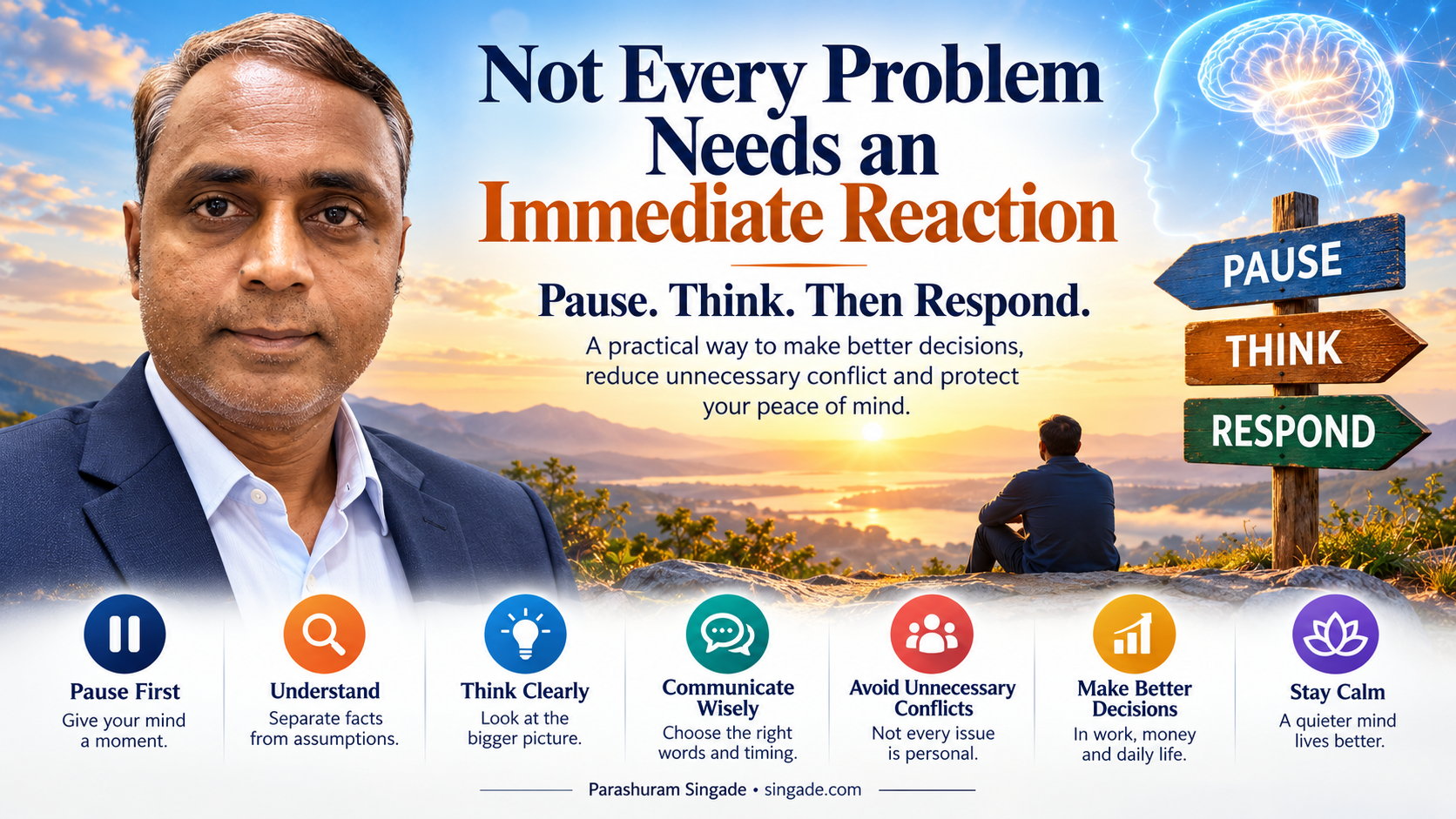
The Power of Pausing Before You Speak, Decide or Act
Modern life trains us to react quickly.
A message arrives—we answer immediately.
Someone disagrees—we defend ourselves immediately.
A customer complains—we become tense immediately.
A problem appears—we start thinking about the worst possible outcome immediately.
But speed is not always intelligence.
Sometimes the smartest response is a pause.
A pause does not mean weakness, fear, laziness or avoidance. It simply gives the brain enough time to separate what happened from how we initially feel about what happened.
That small gap can change a conversation, a business decision, a relationship and sometimes an entire day.
Reaction and Response Are Not the Same
A reaction is often automatic.
Someone says something unpleasant and we immediately reply. Later, we may think, “I should not have said that.”
A response is different. We first understand the situation, think about the consequences and then act.
The event may be the same, but the quality of the decision changes.
This is particularly important in business. An angry email does not always require an angry reply. A delayed payment does not immediately mean that a customer is dishonest. A technical problem does not automatically mean that the entire system has failed.
First understand. Then decide.
Give the Brain a Few Minutes
When something unexpected happens, the first thought is not always the best thought.
Strong emotions can temporarily narrow our attention. We may focus only on the threat, insult or immediate inconvenience and miss other information.
A simple habit can help:
Stop. Observe. Think. Then respond.
Sometimes this takes ten seconds. Sometimes ten minutes. For a major business or personal decision, it may deserve a night of sleep.
The purpose is not to delay every decision. Emergencies require immediate action.
The skill is learning the difference between something that is urgent and something that merely feels urgent.
Never Make Every Problem Personal
One unnecessary burden we carry is converting every event into something about ourselves.
A customer may be frustrated because of their own pressure.
Someone on the road may behave badly because they are impatient.
An employee may make a mistake because they misunderstood instructions.
A family member may be silent because they are tired.
Not everything is an attack.
Before reacting, ask:
“Do I know the full story?”
Very often, we do not.
Written Communication Needs Even More Care
Emails, WhatsApp messages and text messages are useful, but they remove tone of voice and facial expression.
A short message such as “Call me” may look serious even when nothing serious has happened.
This is why emotionally charged replies should rarely be written instantly.
If a message makes you angry, write the reply if necessary—but do not send it immediately. Read it again later.
You may discover that half of the words are unnecessary.
A professional reply should solve the problem, not prove who was more irritated.
Use the 3-Question Test
Before reacting to a difficult situation, ask:
1. What actually happened?
Separate facts from assumptions.
2. Does this require action now?
If not, give yourself time.
3. What outcome do I want?
Winning an argument and solving a problem are not always the same thing.
This simple test can prevent many unnecessary conflicts.
Silence Can Also Be an Answer
We often believe every statement requires a reply.
It does not.
Some arguments survive only because two people continue feeding them.
If a conversation has stopped producing understanding, temporarily ending it may be wiser than continuing.
Silence should not be used to punish someone. But choosing not to participate in an unnecessary argument is a legitimate form of self-control.
Business Decisions Need a Cooling Period
The same principle applies to money.
Excitement can be as dangerous as anger.
A new product, investment, partnership or business opportunity may look excellent during the first conversation.
Do not allow enthusiasm to eliminate verification.
Check the numbers.
Check the terms.
Check what can go wrong.
Ask what happens if revenue is lower than expected.
Ask whether the same decision will still look sensible tomorrow.
Good businesspeople are not those who never take risks. They are those who understand which risks they are taking.
Do Not Carry Every Incident Home
Work requires attention, but work should not occupy the mind twenty-four hours a day.
If something happened at the office, decide whether it needs action today, tomorrow or not at all.
Once the next action has been identified, repeatedly replaying the situation rarely adds value.
Tell yourself:
“I have understood the problem. I know my next action. I do not need to solve it repeatedly in my head.”
This is not forgetting responsibility.
It is preventing responsibility from becoming unnecessary mental load.
A Pause Is Especially Important While Driving
The road is one place where emotional reactions can become dangerous very quickly.
Another driver cuts across your lane. Someone honks unnecessarily. Someone refuses to give way.
The safest response is not to teach that person a lesson.
Let them go.
Your destination is more important than winning a ten-second argument with a stranger.
On the road, ego is expensive.
Teach Children the Same Skill
Children should learn that being intelligent does not mean giving the fastest answer.
It is perfectly acceptable to say:
“I need to think.”
“I do not know yet.”
“Let me check.”
“I was wrong.”
These sentences are signs of maturity, not weakness.
A person who can reconsider a decision is usually more dependable than someone who refuses to change simply to protect pride.
The Goal Is Not to Become Slow
Pausing does not mean becoming indecisive.
With experience, many good decisions can be made quickly.
The purpose is to prevent emotion from pretending to be judgment.
When immediate action is necessary, act.
When time is available, use it.
My Simple Rule
When something disturbs me, I try to remember:
Do not react to the first emotion. Understand the situation, decide what matters, and then respond.
The world already contains enough noise.
We do not have to add our own unnecessary reactions to it.
A calm mind does not ignore problems.
It simply refuses to give every problem the same level of importance.
Leave a comment