How to Verify a 305 Meterts CAT6 LAN Cable Box
Weight, copper conductor, cable length and
resistance checks — using a D-Link CAT6 box as a practical field example
By Parashuram Singade |
Technical note for singade.com

Field
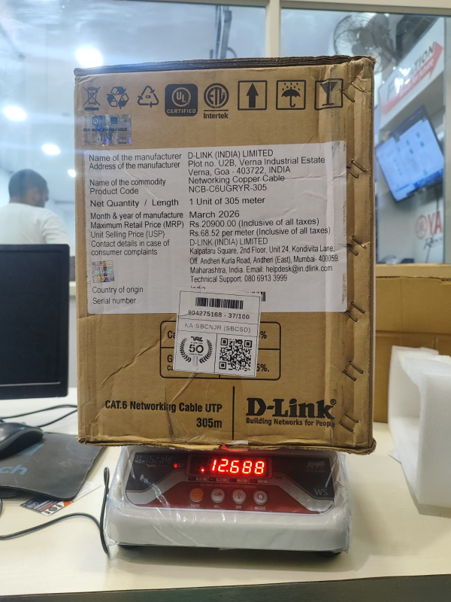
measurement: the sealed 305 m D-Link CAT6 cable box shown here reads 12.688 kg
on the scale. The reading is a useful screening clue, not proof of authenticity
by itself.
|
Suggested title |
How to
Verify a 305 m CAT6 LAN Cable Box: Weight, Copper, Length & Resistance |
|
Suggested slug |
verify-cat6-cable-weight-copper-length-resistance |
|
Meta description |
A
practical method to check a 305 m CAT6 LAN cable box using gross weight,
conductor material, meter markings, DC resistance and certification testing. |
|
Focus keywords |
CAT6 cable
weight, 305m LAN cable, copper CAT6 cable, D-Link CAT6, cable resistance test |
A cable box can look genuine and still deserve verification
For
structured cabling, the cable itself is the foundation of the network. Switches, access points and servers can be replaced later, but
replacing cable hidden above ceilings, inside conduits or behind walls is
expensive and disruptive. That is why it makes sense to perform a few basic
checks before a 305 m CAT6 box is accepted for installation.
In this example, a D-Link CAT6 UTP 305 m
box with product code NCB-C6UGRYR-305
was placed on a digital scale. The displayed gross weight was 12.688 kg. That reading is physically
plausible for a full box of solid-copper CAT6 cable, but weight alone cannot
prove that the cable is genuine, full-length or compliant.
|
Key point Use weight as the first filter. Use conductor
inspection, sequential length markings, DC resistance and a certification
tester for stronger evidence. |
The
number on the scale is the gross box weight. It
includes the cable, insulation, separator, outer jacket, spool or payout
arrangement, carton and labels. Because manufacturers can use different
conductor gauges, jacket compounds and packaging, there is no single universal
“correct CAT6 box weight.”
For
the box photographed in this article, 12.688 kg is not an obvious red flag. A drastically lighter box, however, would justify more investigation
— especially if the product is sold as solid bare copper.
Field sample quick reference
|
Item |
Observation /
reference |
Why it matters |
|
Box length |
305 m |
Standard
bulk-cable packaging length |
|
Measured
gross weight |
12.688 kg |
Useful for
screening unusually light product |
|
Cable type |
CAT6 UTP |
Intended
for balanced twisted-pair Ethernet cabling |
|
Product
code on box |
NCB-C6UGRYR-305 |
Use this
exact code when checking datasheets and invoices |
|
Manufacturer
datasheet |
Solid bare
copper; exact AWG can vary by product revision/variant |
Do not
assume conductor gauge only from the CAT6 label |
Start
with the exact part number, not merely the brand name or the words “CAT6.” D-Link publishes multiple CAT6 constructions and variants. Current
and older official datasheets show solid bare copper CAT6 products in both 23
AWG and 24 AWG families. The cable jacket and the datasheet corresponding to
the actual part/revision should therefore be treated as the reference.
·
Confirm the product code
printed on the carton, invoice and cable jacket.
·
Look for sequential metre
markings on the cable jacket. D-Link datasheets specify a sequential length
counter printed on each metre for the referenced CAT6 products.
·
Check that brand, category,
conductor specification, compliance markings and batch information are
consistently printed and legible.
·
Photograph the unopened carton
label and serial/batch markings before installation. This creates a traceable
project record.
CCA
(copper-clad aluminium) cable can look copper-coloured from the outside. A visual check of the surface alone is therefore weak evidence. If a
small sample can be sacrificed, cut the conductor cleanly and inspect the
cross-section. A solid-copper conductor should remain copper-coloured through
the centre; a CCA conductor typically shows a silvery aluminium core beneath a
thin copper layer.
·
Cross-section check: inspect a
cleanly cut conductor end under good light or magnification.
·
Scrape test: lightly scrape the
conductor surface; a change from copper colour to a silvery core is a warning
sign.
·
Magnet test: useful only for
detecting ferrous/steel content. Aluminium is not magnetic, so a non-magnetic
result does not prove solid copper.
·
Micrometer check: measure the
bare conductor diameter and compare it with the exact manufacturer datasheet
for that product variant.
Bulk
LAN cable should carry sequential length markings. Record
the starting and ending metre marks during installation. The difference should
correspond with the amount of cable actually used. This is also useful for
estimating the remaining quantity without weighing the box again.
Practical
tip: Before pulling the first cable, photograph the
initial metre marking. When a run is completed, photograph the final marking
and record the run ID. This simple habit improves inventory control and dispute
resolution.
Resistance
testing is one of the most useful checks because conductor material and
conductor size directly affect resistance. The
D-Link datasheets referenced below specify conductor resistance below
approximately 9.38 Ω per 100 m for the solid-copper CAT6 constructions shown.
|
Reference conductor
resistance |
< 9.38
Ω / 100 m |
|
Approx. upper value for one 305 m conductor |
< 28.6
Ω |
|
Approx. upper loop value using two 305 m conductors |
< 57.2
Ω |
|
Test method |
Short a
pair at the far end and measure the loop at the near end |
Important:
The figures above are a practical approximation
derived from the datasheet limit. Copper resistance changes with temperature,
and ordinary multimeters add lead/contact error. For acceptance testing, use
calibrated test equipment and the limits applicable to the exact cable and
cabling standard.
A
box can pass a weight check and still fail as a network cable. After termination, certify representative or required links using a
proper cable certification tester such as a Fluke Networks DSX-series
instrument or equivalent. A certification test checks the electrical
performance of the complete installed channel or permanent link, including
parameters such as insertion loss, NEXT, return loss and wire map.
|
For professional installations Do not stop at a continuity tester. Continuity
proves that conductors are connected; certification verifies whether the
installed link actually meets the required CAT6 performance limits. |
·
☐ Invoice description and
product code match the carton.
·
☐ Manufacturer/batch/serial
information is photographed and recorded.
·
☐ Carton is sealed and shows no
obvious tampering or water damage.
·
☐ Gross weight is recorded
before use.
·
☐ Cable jacket printing is
clear and includes sequential length markings.
·
☐ A sample conductor is
consistent with solid bare copper when permitted.
·
☐ Bare conductor diameter
matches the exact datasheet/revision.
·
☐ DC loop resistance is within
the applicable limit.
·
☐ Installed links are
tested/certified and reports are retained with the project documents.
The
12.688 kg reading in this field example is reasonable for a full 305 m CAT6
cable box and does not, by itself, indicate a problem. The better approach is to combine several independent checks: exact
product identification, jacket markings, copper cross-section, conductor
diameter, DC resistance and final link certification.
That
layered method is simple, repeatable and far more defensible than accepting or
rejecting cable based on weight alone. For
commercial projects, save the photographs, resistance readings and
certification reports along with the invoice and material approval records.
|
Technical note Product specifications can change by model suffix,
manufacturing revision and market. Always use the datasheet that matches the
exact part number printed on the cable/carton. The checks in this article are
practical screening and QA methods; they do not replace manufacturer
authentication or formal cabling certification. |
1. D-Link India — CAT6 UTP Cable datasheet,
part code NCB-C6UGRYR-305 (solid bare copper, 305 m; current referenced
document). Open D-Link PDF
2. D-Link India — CAT6 UTP INX Cable
datasheet, NCB-C6UGRYR-305/INX (24 AWG solid bare copper, 305 m). Open D-Link PDF
3. D-Link India — Download / Resource
Centre. D-Link Datasheets
Leave a comment