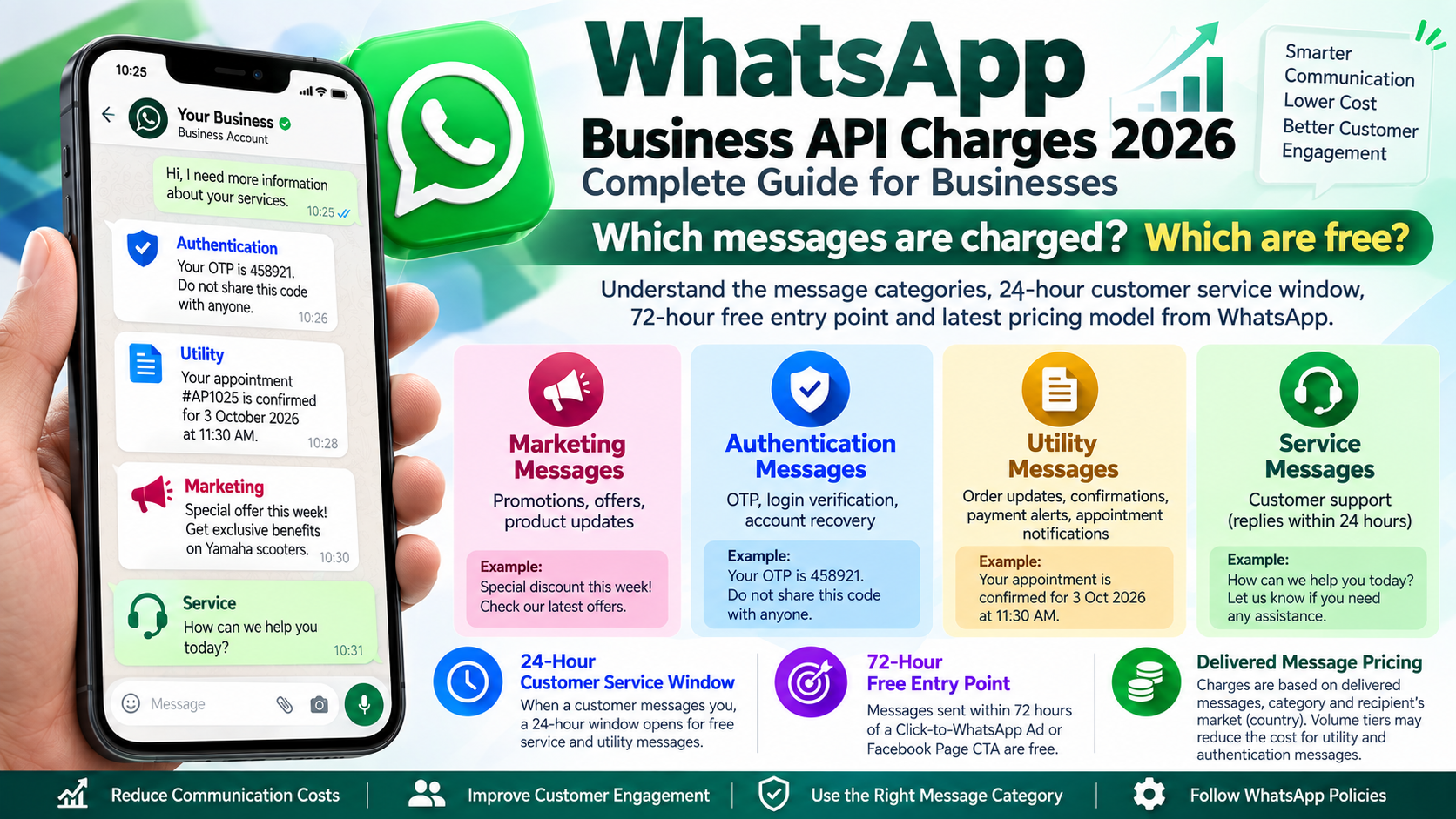
WhatsApp
Business API Charges 2026:
What
Is Charged, What Is Free, and How Billing Works
Updated: 1 October 2026
WhatsApp is now a major business
communication channel for appointment confirmations, order updates, OTPs,
payment reminders, support, lead follow-ups and marketing campaigns.
The pricing model is often misunderstood.
Under the current WhatsApp Business Platform model, businesses are charged on a
per-message basis for messages that are delivered to users. The applicable rate
depends on the recipient market and the message category.
WhatsApp uses four principal message
categories: Marketing, Utility, Authentication and Service.
Official
reference: WhatsApp Business Platform Pricing | https://business.whatsapp.com/products/platform-pricing
WhatsApp states that it charges when a
message is delivered, not merely when it is sent. Pricing is determined by who
receives the message and the category of the message.
This distinction matters when reconciling
your application logs with your WhatsApp bill: a send request and a successful
delivery are not the same billing event.
Official
reference: WhatsApp Business Platform Pricing | https://business.whatsapp.com/products/platform-pricing
1. Marketing Messages
Marketing messages are used for promotions,
offers, product recommendations, re-engagement and other messages intended to
drive awareness or sales.
Examples include discounts, new-product
announcements, price-drop notifications, abandoned-cart reminders and
promotional campaigns.
Marketing templates are normally billable
even when the ordinary 24-hour customer service window is open. An eligible
Free Entry Point window is an important exception.
Official
reference: WhatsApp Marketing Messages | https://business.whatsapp.com/products/conversation-categories/marketing
2. Utility Messages
Utility messages are non-promotional
messages that are typically triggered by a user action or an existing
transaction.
Examples include appointment confirmations,
order confirmations, delivery updates, payment confirmations, account updates
and transaction-related reminders.
WhatsApp states that it does not charge for
utility messages that businesses send in response to users. Outside the
applicable free window, utility template messages can be billable.
Keep utility templates genuinely
transactional. Adding promotional language can affect how a template is
categorized.
Official
reference: WhatsApp Utility Messages | https://business.whatsapp.com/products/conversation-categories/utility
3. Authentication Messages
Authentication messages use one-time
passwords (OTPs) for identity verification.
Common uses include registration, login
verification, account recovery and transaction verification.
Authentication templates are normally
billed at the applicable authentication rate. WhatsApp also provides volume
tiers for utility and authentication messages, allowing more attractive pricing
as eligible message volume grows.
Official
reference: WhatsApp Authentication Messages | https://business.whatsapp.com/products/conversation-categories/authentication
4. Service Messages
Service messages are replies to incoming
customer enquiries handled by an agent, chatbot or conversational support
system.
When a user messages a business, a 24-hour
customer service window opens. During this window, businesses can respond with
service messages at no charge. The window resets each time the user sends a new
message.
Outside this window, businesses generally
need an approved message template to initiate or resume business-initiated
messaging.
Official
reference: WhatsApp Service Messages | https://business.whatsapp.com/products/conversation-categories/service
The 24-hour Customer Service Window (CSW)
starts when the customer sends a message to the business and resets whenever
the customer sends another message.
During an open CSW, service messages are
free and utility messages sent in response to the user are free. Marketing and
Authentication template messages remain billable under normal pricing unless
another free-window rule applies.
·
Service / free-form replies:
Free inside the CSW.
·
Utility messages sent in
response to users: Free inside the CSW.
·
Marketing templates: Billable
under normal pricing.
·
Authentication templates:
Billable under normal pricing.
Official
reference: WhatsApp Business Platform Pricing | https://business.whatsapp.com/products/platform-pricing
WhatsApp provides a separate Free Entry
Point benefit. When a customer sends a message from an Ad that Clicks to
WhatsApp or a Facebook Page call-to-action button, WhatsApp states that all
message categories are not charged for the following three days, or 72 hours.
This can be particularly useful for
lead-generation campaigns that begin with a Click-to-WhatsApp advertisement.
The 72-hour Free Entry Point is separate
from the ordinary 24-hour Customer Service Window.
Official
reference: WhatsApp Business Platform Pricing | https://business.whatsapp.com/products/platform-pricing
WhatsApp does not apply one universal
global rate. Rates vary by market and message category.
India is listed as a separate market in the
official pricing tool. Businesses should check the current official rate for
the relevant market, currency and category before putting a fixed amount into a
proposal, website or software screen.
Official
reference: WhatsApp Business Platform Pricing | https://business.whatsapp.com/products/platform-pricing
WhatsApp offers volume tiers for Utility
and Authentication messages. As eligible monthly message volume increases, a
business can unlock more attractive pricing within the applicable tiers.
The official pricing page includes tools
for reviewing rates and estimating charges for the selected market and message
category.
Official
reference: WhatsApp Business Platform Pricing | https://business.whatsapp.com/products/platform-pricing
Businesses are responsible for obtaining
the required permissions and consents for customer communication. Customers
should know what types of messages they can expect to receive.
Possessing a customer phone number should
not be treated as automatic permission to send promotional WhatsApp messages.
Clear opt-in and opt-out practices are important for policy compliance and
customer trust.
Official
reference: WhatsApp
Business Messaging Policy | https://business.whatsapp.com/policy/preview
These pricing rules primarily concern the
WhatsApp Business Platform/API used for programmatic messaging, automation, CRM
integration and larger-scale communication. They should not be confused with
the ordinary WhatsApp Business mobile app used manually by many small
businesses.
Official
reference: WhatsApp Business Platform Pricing | https://business.whatsapp.com/products/platform-pricing
WhatsApp platform charges may not be your
only cost. A Business Solution Provider, CRM, messaging gateway or other
third-party platform may add subscription fees, hosting fees, markup or
automation charges.
When comparing providers, separate official
WhatsApp/Meta message charges from the provider’s own commercial fees.
The simplest way to understand WhatsApp
Business Platform pricing in 2026 is this: service replies inside the 24-hour
customer service window are free; utility messages sent in response to users
can be free; marketing and authentication templates are normally billable; and
an eligible 72-hour Free Entry Point can make all message categories free from
WhatsApp platform charges during that period.
For accurate budgeting, always verify the
current official WhatsApp rate for the recipient market and message category.
Official
reference: WhatsApp Business Platform Pricing | https://business.whatsapp.com/products/platform-pricing
|
Message Type |
Outside CSW |
Inside CSW |
Inside 72-hour FEP |
|
Marketing template |
Billable |
Billable |
Free |
|
Authentication template |
Billable |
Billable |
Free |
|
Utility template |
Billable |
Free* |
Free |
|
Service / free-form |
Not available as normal free-form |
Free |
Free |
*
Utility messages sent in response to users within the applicable customer
service window.
Official
reference: WhatsApp Business Platform Pricing | https://business.whatsapp.com/products/platform-pricing
|
Example |
Category |
|
Your appointment #AP1025 is confirmed for 3 October at 11:30 AM. |
Utility |
|
Your order #45821 has been dispatched. |
Utility |
|
482915 is your login verification code. |
Authentication |
|
Get 20% off this weekend on selected products. |
Marketing |
|
Customer: 'What time is my appointment?' Business: 'It is at 2 PM
today.' |
Service |
The following are the official sources used
for this article. The full URLs are shown so they remain visible even if a
website editor strips hyperlink formatting during copy and paste.
·
WhatsApp Business Platform Pricing: https://business.whatsapp.com/products/platform-pricing
·
WhatsApp Marketing Messages: https://business.whatsapp.com/products/conversation-categories/marketing
·
WhatsApp Utility Messages: https://business.whatsapp.com/products/conversation-categories/utility
·
WhatsApp Authentication Messages: https://business.whatsapp.com/products/conversation-categories/authentication
·
WhatsApp Service Messages: https://business.whatsapp.com/products/conversation-categories/service
·
WhatsApp Business Messaging Policy: https://business.whatsapp.com/policy/preview
Publishing
/ new-tab requirement: The companion HTML file
supplied with this Word document uses target="_blank" and
rel="noopener noreferrer" on every official external link. This
guarantees new-tab behaviour when that HTML is pasted or imported into a
compatible CMS/source editor. The Word document also contains clickable
external hyperlinks and keeps the full official URLs visible.
Leave a comment